Safety profile similar to IV decitabine1,2
MDS Safety
Adverse reactions and lab abnormalities in patients with MDS and CMML
- Incidence of cytopenias was slightly higher in patients taking INQOVI during Cycle 1 compared with those receiving IV decitabine1,3
- In the pooled safety population of Phases 2 and 3, 61% of patients receiving INQOVI were exposed for ≥6 months and 24% were exposed for >1 year1
- In the long-term follow-up, the adverse event (AE) profile was similar to what was observed in the pooled safety population1,2
- The incidence of serious adverse reactions (ARs) in Cycles 1 and 2 was 31% (40/130) with oral decitabine-cedazuridine and 18% (24/132) with IV decitabine2
Adverse reactions reported in ≥10% of patients in the pooled Phase 2 and Phase 3 safety population1
| ADVERSE REACTIONSa | INQOVI CYCLE 1 (N=107) | IV DECITABINE CYCLE 1 (N=106) | INQOVI ALL CYCLES (N=208c) | |||
|---|---|---|---|---|---|---|
| ALL GRADES (%) | GRADE 3 OR 4 (%) | ALL GRADES (%) | GRADE 3 OR 4 (%) | ALL GRADES (%) | GRADE 3 OR 4 (%) | |
| GENERAL DISORDERS AND ADMINISTRATION SITE CONDITIONS | ||||||
| Fatigueb | 29 | 2 | 25 | 0 | 55 | 5 |
| Hemorrhageb | 24 | 2 | 17 | 0 | 43 | 3 |
| Edemab | 10 | 0 | 11 | 0 | 30 | 0.5 |
| Pyrexia | 7 | 0 | 7 | 0 | 19 | 1 |
| GASTROINTESTINAL DISORDERS | ||||||
| Constipationb | 20 | 0 | 23 | 0 | 44 | 0 |
| Mucositisb | 18 | 1 | 24 | 2 | 41 | 4 |
| Nausea | 25 | 0 | 16 | 0 | 40 | 0.5 |
| Diarrheab | 16 | 0 | 11 | 0 | 37 | 1 |
| Transaminase increasedb | 12 | 1 | 3 | 0 | 21 | 3 |
| Abdominal painb | 9 | 0 | 7 | 0 | 19 | 1 |
| Vomiting | 5 | 0 | 5 | 0 | 15 | 0 |
| MUSCULOSKELETAL AND CONNECTIVE TISSUE DISORDERS | ||||||
| Myalgiab | 9 | 2 | 16 | 1 | 42 | 3 |
| Arthralgiab | 9 | 1 | 13 | 1 | 40 | 3 |
| RESPIRATORY, THORACIC, AND MEDIASTINAL DISORDERS | ||||||
| Dyspneab | 17 | 3 | 9 | 3 | 38 | 6 |
| Coughb | 7 | 0 | 8 | 0 | 28 | 0 |
| BLOOD AND LYMPHATIC SYSTEM DISORDERS | ||||||
| Febrile neutropenia | 10 | 10 | 13 | 13 | 33 | 32 |
| SKIN AND SUBCUTANEOUS TISSUE DISORDERS | ||||||
| Rashb | 12 | 1 | 11 | 1 | 33 | 0.5 |
| NERVOUS SYSTEM DISORDERS | ||||||
| Dizzinessb | 16 | 1 | 11 | 0 | 33 | 2 |
| Headacheb | 22 | 0 | 13 | 0 | 30 | 0 |
| Neuropathyb | 4 | 0 | 8 | 0 | 13 | 0 |
| METABOLISM AND NUTRITIONAL DISORDERS | ||||||
| Decreased appetite | 10 | 1 | 6 | 0 | 24 | 2 |
| INFECTIONS AND INFESTATIONS | ||||||
| Upper respiratory tract infectionb | 6 | 0 | 3 | 0 | 23 | 1 |
| Pneumoniab | 7 | 7 | 7 | 5 | 21 | 15 |
| Sepsisb | 6 | 6 | 2 | 1 | 14 | 11 |
| Cellulitisb | 4 | 1 | 3 | 2 | 12 | 5 |
| INVESTIGATIONS | ||||||
| Renal impairmentb | 9 | 0 | 8 | 1 | 18 | 0 |
| Weight decreased | 5 | 0 | 3 | 0 | 10 | 1 |
| INJURY, POISONING, AND PROCEDURAL COMPLICATIONS | ||||||
| Fall | 4 | 0 | 1 | 0 | 12 | 1 |
| PSYCHIATRIC DISORDERS | ||||||
| Insomnia | 6 | 0 | 2 | 0 | 12 | 0.5 |
| VASCULAR DISORDERS | ||||||
| Hypotensionb | 4 | 0 | 6 | 1 | 11 | 2 |
| CARDIAC DISORDERS | ||||||
| Arrhythmiab | 3 | 0 | 2 | 0 | 11 | 1 |

aPlease see full Prescribing Information for complete list of ARs occurring during all cycles.
bIncludes multiple AR terms.
cIncludes ARs that occurred during all cycles, including during treatment with 1 cycle of IV decitabine.
Select hematologic lab abnormalities (>20%) worsening from baseline in the pooled safety population1
| LAB PARAMETERa | INQOVI CYCLE 1b | IV DECITABINE CYCLE 1b | INQOVI ALL CYCLESb | |||
|---|---|---|---|---|---|---|
| ALL GRADES (%) | GRADE 3 OR 4 (%) | ALL GRADES (%) | GRADE 3 OR 4 (%) | ALL GRADES (%) | GRADE 3 OR 4 (%) | |
| HEMATOLOGY | ||||||
| Leukocytes decreased | 79 | 65 | 77 | 59 | 87 | 81 |
| Platelet count decreased | 79 | 65 | 77 | 67 | 82 | 76 |
| Neutrophil count decreased | 70 | 65 | 62 | 59 | 73 | 71 |
| Hemoglobin decreased | 58 | 41 | 59 | 36 | 71 | 55 |
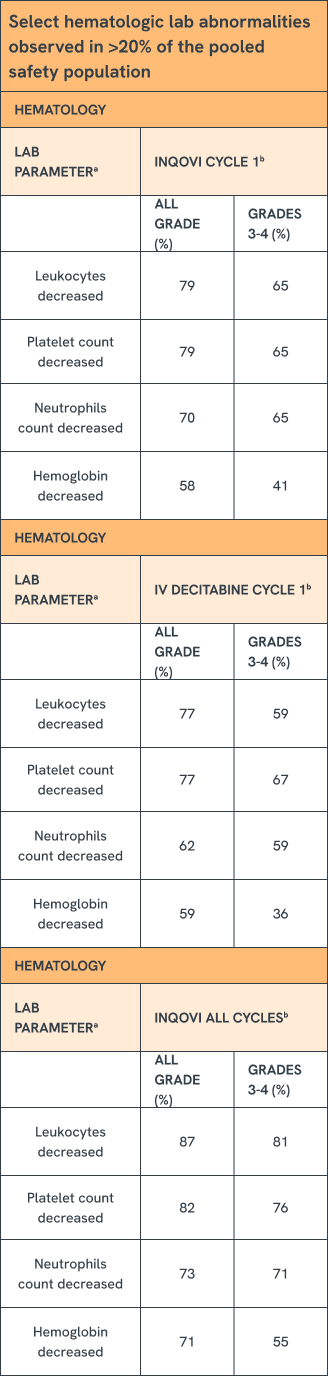
aIncludes any lab abnormalities that worsened by ≥1 grades. Grades 3 to 4 include any lab abnormalities that worsened to Grade 3 or Grade 4.
bThe denominator used to calculate the rate varied from 103 to 107 for INQOVI Cycle 1, from 102 to 106 for the IV decitabine Cycle 1, and from 203 to 208 for INQOVI (all cycles) based on the number of patients with a baseline value and ≥1 post-treatment value.
Please see full Prescribing Information for chemistry lab safety parameters.
Fatal ARs occurred in 6% of patients1
- These included sepsis (1%), pneumonia (1%), respiratory failure (1%), septic shock (1%), and 1 case each of cerebral hemorrhage and sudden death1
- Also in the long-term follow-up, 11 (8%) of 133 participants had fatal treatment-emergent serious ARs during the study. 5 of these deaths were deemed treatment related; 2 to oral therapy (sepsis and pneumonia) and 3 to IV treatment (septic shock [n=2] and pneumonia [n=1])2
Permanent discontinuation due to an AR occurred in 5% of patients1
- 1 participant in each group discontinued treatment during the first 2 cycles due to an AR2
- Overall treatment discontinuations due to an AR included 1 (out of 132) receiving IV decitabine and 2 (out of 130) receiving oral decitabine-cedazuridine2
- The most frequent ARs resulting in permanent discontinuation were febrile neutropenia (1%) and pneumonia (1%)1
- The most common reason for treatment discontinuation was undergoing allogeneic hematopoietic stem-cell transplantation (HSCT) (27 [20%])2
Dose interruptions due to an AR occurred in 41% of patients1
- ARs requiring dose interruptions in ≥5% of INQOVI patients included neutropenia (18%), febrile neutropenia (8%), thrombocytopenia (6%), and anemia (5%)
Dose reductions due to an AR occurred in 19% of patients1
- ARs requiring dose reductions in >2% of patients included neutropenia (12%), anemia (3%), and thrombocytopenia (3%)
Additional safety profile information1
- Clinically relevant ARs in <10% of patients who received INQOVI tablets included acute febrile neutrophilic dermatosis (Sweet's syndrome) (1%) and tumor lysis syndrome (0.5%)
- Serious ARs occurred in 68% of patients who received INQOVI. Serious ARs in >5% of patients included febrile neutropenia (30%), pneumonia (14%), and sepsis (13%)
Dosing guidance
Guidance on INQOVI dosing may help support treatment.

How to start patients
Patients can be started on INQOVI in both inpatient and outpatient settings.1
References: 1. INQOVI [package insert]. Princeton, NJ: Taiho Oncology, Inc.; 2026. 2. Garcia-Manero G, McCloskey J, Griffiths EA, et al. Oral decitabine-cedazuridine versus intravenous decitabine for myelodysplastic syndromes and chronic myelomonocytic leukaemia (ASCERTAIN): a registrational, randomised, crossover, pharmacokinetics, phase 3 study. Lancet Haematol. 2024;11(1):e15-e26. 3. Kim N, Norsworthy KJ, Subramaniam S, et al. FDA approval summary: decitabine and cedazuridine tablets for myelodysplastic syndromes. Clin Cancer Res. 2022;28(16):3411-3416.