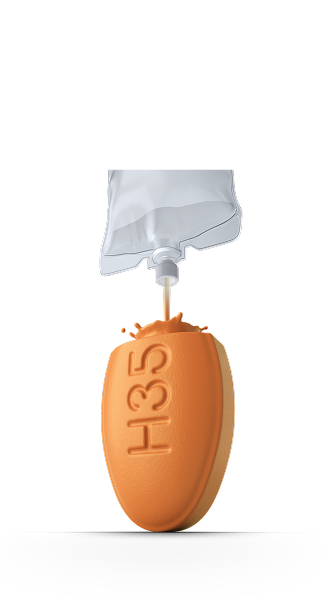
INQOVI delivered equivalent systemic exposure to IV decitabine1,2
MDS Efficacy
Illustrative only. Not actual size.
Contains decitabine and cedazuridine.
Primary endpoint outcome
99
ratio of oral to IV 5-day decitabine AUC (indicating equivalent pharmacokinetic exposure) (90% CI: 93%-106%)1,2*
This ratio is the geometric mean of the 5-day cumulative decitabine AUC between INQOVI and IV-administered decitabine when administered once daily for 5 consecutive days.1
*Excludes data from some participants due to data confidence or quality issues.2
Secondary endpoint outcomes
Clinical response2
70
of MDS patients experienced a clinical response, showing improvements like complete or partial response, complete marrow response, and hematological improvement†
Evaluable participants: 82 of 117 (95% CI: 50%–69%)
†Based on International Working Group 2006 MDS response criteria.2
CR in patients with MDS or CMML
| ENDPOINT | PHASE 3 (N=133)1,2 | PHASE 3 LONG-TERM FOLLOW-UP (N=133)2 |
|---|---|---|
| Median follow-up time | 12.6 months (range: 9.3-20.5)1 | ~32 months (IQR: ~30-35)2 |
| Patients who achieved complete response (CI)a | 21% (95% CI: 15%-29%)1 | 25% (95% CI: 17%-34%)2b |
| Median duration of CR (range)c | 7.5 months (1.6-17.5)1 | 14.1 months (11.7-18.7)2 |
| Median time of CR (range)a | 4.3 months (2.1-15.2)1 | 4.5 months (2.1-18.7)3 |
aComplete or partial response may take longer than 4 cycles.1
bOf the evaluable 117 participants, 25% (29/117) achieved a CR.2
cFrom start of CR until relapse or death.1
IQR=interquartile range
Rates of transfusion independence were consistent at the long-term follow-up2
Phase 3 results (N=133)1,2
- Among the 57 patients who were dependent on red blood cell (RBC) and/or platelet transfusions at baseline, 30 (53%) became independent of RBC and platelet transfusions during any 56-day post-baseline period
- Of the 76 patients who were independent of both RBC and platelet transfusions at baseline, 48 (63%) remained transfusion independent during any 56-day post-baseline period
Phase 3 long-term follow-up results (N=133)2
- Among the 54 patients who were RBC transfusion dependent at baseline, 28 (52%) achieved RBC transfusion independence during the study
- Of the 12 patients who required platelet transfusions at baseline, 6 (50%) achieved platelet transfusion independence during the study
- 33% of patients in each category (RBC: 18/54; platelet: 4/12) who were transfusion dependent at baseline maintained transfusion independence for at least 112 consecutive days
NCCN CATEGORY 2A RECOMMENDED
The National Comprehensive Cancer Network® (NCCN®) recommends decitabine and cedazuridine (INQOVI) as a Category 2A possible substitution for IV decitabine in MDS (IPSS Intermediate-1 and above).4*
Do not substitute INQOVI for an IV decitabine product within a cycle.
*Category 2A=based upon lower-level evidence, there is uniform NCCN consensus (≥85% support of the Panel) that the intervention is appropriate.4
NCCN makes no warranties of any kind regarding their content, use or application and disclaims any responsibility for their application or use in any way.

MDS safety
INQOVI showed a safety profile similar to IV decitabine in the Phase 3 clinical trial.1,2

How to start patients
Patients can be started on INQOVI in both inpatient and outpatient settings.1
References: 1. INQOVI [package insert]. Princeton, NJ: Taiho Oncology, Inc.; 2026. 2. Garcia-Manero G, McCloskey J, Griffiths EA, et al. Oral decitabine/cedazuridine versus intravenous decitabine for myelodysplastic syndromes and chronic myelomonocytic leukaemia (ASCERTAIN): a registrational, randomised, crossover, pharmacokinetics, phase 3 study. Lancet Haematol. 2024;11(1):e15-e26. 3. Data on file. Taiho Oncology Inc., Princeton, NJ. 4. Referenced with permission from the NCCN Clinical Practice Guidelines in Oncology (NCCN Guidelines®) for Myelodysplastic Syndromes V.1.2026. © National Comprehensive Cancer Network, Inc. 2025. All rights reserved. Accessed January 27, 2026. To view the most recent and complete version of the guidelines, go online to NCCN.org.